

Week 9: The Advocacy Project
- May 29, 2016
- 3 min read
The Beginning
The advocacy project initially started with choosing a topic to write about for the literature review. I had always been interested in switching to a plant-based diet and have always have seen how intelligent other animals can be given that I have a had a multitude of pets throughout my childhood and have respected the cleverness that they sometimes display. Thus, I knew I wanted to write about an industry that currently regards how little thought for how intelligent animals, pigs in particular, can be. This reflects one of the habits of mind: curiosity. I had never quite developed a sound moral basis for becoming a vegan and so exploring this topic would truly make me more confident in my lifestyle choices and simply gather more information to arm myself with so that I could make the best possible decisions that I could.
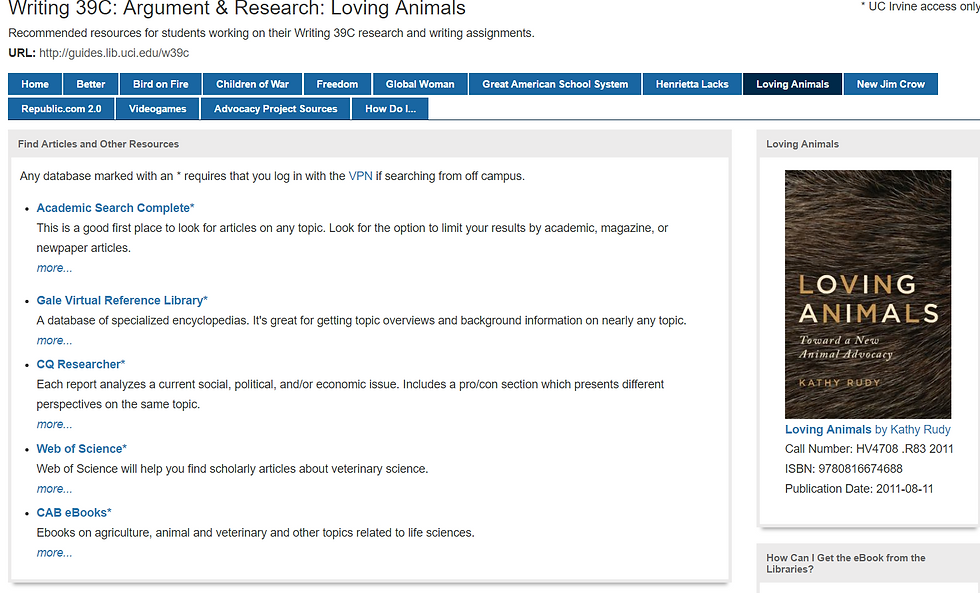
I therefore chose pig cognition for the HCP and did extensive research through the UCI catalogs and the “Ask a Librarian” chat in order to find the most reliable research studies that would demonstrate their intelligence. Key words I used to find the most reliable research studies included “pig”, “cognition”, “intelligence”, “emotion”, “memory”, “researchers”, and “pig experiments.” The last few resulted in the most amount of results because I was able to find studies done by Marino and Gieling. This also reflects another habit of mind: persistence. It was very difficult in finding actual experimental studies that manipulated variables in a controlled study. Many professors had written scientific reviews about pig cognition but not had conducted experiments themselves.
Some of the websites I used were Academic Search Complete, nature.com, and virtually all of the catalog search bar options on the UCI resources page. The most useful search tool was the Academic Search Complete because it gave me the most amount of studies that were actual experiments that demonstrated pig intelligence.
In the actual essay for the advocacy project, I had to cut down my HCP to about 3.5 pages. Doing this was very hard to do so because all my transitions embedded in my HCP had to be removed and rewritten so that it would connect to the advocacy part of the project, rather than review the literature. For example, I attempted to foreshadow each part of the problem and continue to hint at the solutions in my essay throughout the drafts. For instance, I decided to choose the most important studies that actually had an impact on the pigs' wellbeing. The study about emotion was most important because it showed that pigs could indeed experience a range of emotions that was directly experienced in pig factories themselves. This involves flexibility: I had to rearrange a 10 page detailed essay into a 3 page summary of the most important works of pig experiments. This forced me to be more fluid in my writing and be able to think critically about what parts were the most relevant and how to write it in a manner that would flow easily and still make sense in the overall draft.
I decided to frame my problem using as much logos and ethos as I could. I started off with a paragraph introducing the problem in the first and place and what aspects of the solution I would address. This included discussing the political, economic, and social aspects of pig factory farming. I had to open by exploring various concepts of the problem at hand and think about all of the sub-problems that were involved in pig factory farming in the first place.
The multi-modal elements I used were to simply illustrate a visual picture of what all of the facts and statistics that I stated in my draft. For instance, I included a picture of the gestation crates that were often used in pig farms in order to convince my reader that the pig farms were actually very miniscule and caused unnecessary suffering to the pigs.
After the first draft, I knew I needed some serious revising. I needed to expand my historical literature review to fully focus on all the aspects that problem focused on, such as registering and remembering the suffering, and propose more solutions that were specific and that were back up with professional sources that were quite plausible. When I got to the final proofreading state, I decided to entirely rewrite the problem and solution in order to advocate the point that pig farming is unsustainable and causes a huge onset of problems that often not thought about. This required engagement in the research that I was doing because I needed to connect interdisplinary concepts across the board.


Comments